Sunk Cost Fallacy Explained Simply: Why Letting Go Can Be the Smartest Decision
What Is It?
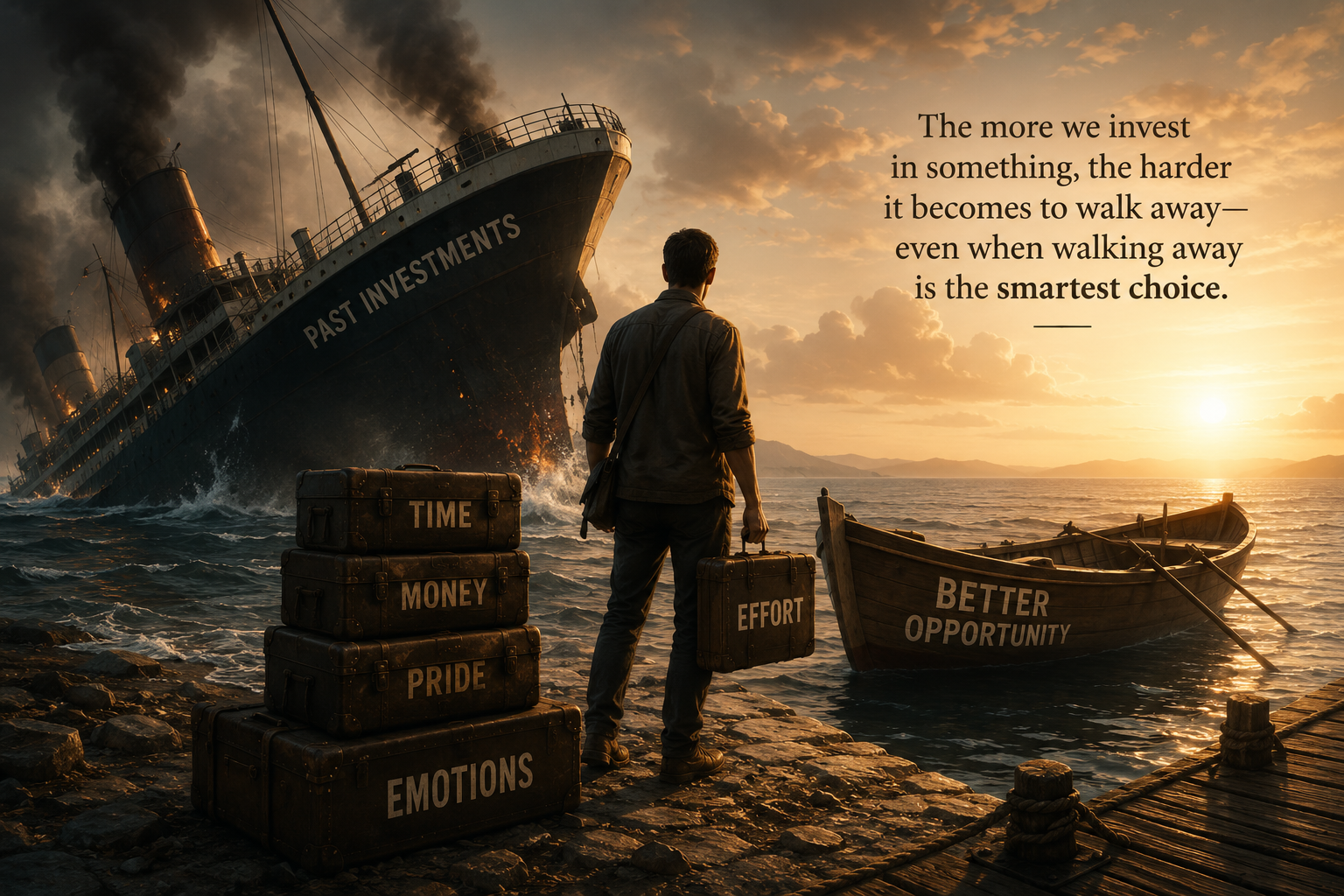
The Sunk Cost Fallacy is the tendency to continue investing time, money, effort, or emotions into something because of what you’ve already invested, even when future benefits no longer justify continuing.
Economists call past investments “sunk costs.” They’re gone, you cannot recover them, yet our brains often behave as if continuing will somehow make those past investments worthwhile.
Instead of asking: “What’s the best decision today?”
We ask: “How can I justify everything I’ve already put into this?”
That’s where costly mistakes begin.
Why It Matters
Every day, people stay stuck because of sunk costs. This is not because continuing is the best option, but because quitting feels like admitting failure.
The result?
People remain in:
- Unhealthy relationships
- Unprofitable businesses
- Degrees they no longer enjoy
- Jobs they dread
- Investments that continue losing value
- Projects that no longer make sense
The greatest cost often isn’t what you’ve already lost. It’s what you’ll continue to lose if you refuse to change course.
The Mental Model
Imagine you’ve paid for a concert ticket. The day arrives, you’re sick and you don’t feel like going.
Many people still force themselves to attend.
Why?
“I already paid for the ticket.”
But the money is already gone. Whether you attend or stay home, you don’t get it back.
The real question becomes: “Which choice gives me the better outcome from this point forward?”
That’s the heart of the Sunk Cost Fallacy.
Example
Imagine you’ve spent three years building a business, and then you discover that customers don’t actually want the product. You now have two choices.
Option A: Keep investing simply because you’ve already spent three years.
Option B: Accept the lesson, pivot, and build something customers actually want.
Many entrepreneurs choose Option A. This is not because it’s better, but because abandoning three years feels painful. But continuing only increases the loss.
Why Our Brains Struggle
Our brains dislike waste. We hate feeling like we’ve:
- Wasted money.
- Wasted time.
- Wasted effort.
- Made a mistake.
So we keep investing.
Ironically, this often creates even bigger losses. The desire to avoid admitting a mistake causes us to make a larger one.
The Hidden Trap
The Sunk Cost Fallacy is rarely about money, it’s often about identity.
People think:
“I’ve spent ten years becoming this.”
“I’ve always been known for this.”
“What will people think if I quit?”
Sometimes we stay because leaving forces us to redefine ourselves.
Successful People Pivot
Many successful people aren’t successful because they never fail. They’re successful because they stop investing in bad decisions earlier than others.
They understand that persistence is valuable, but persistence without reflection becomes stubbornness.
Wisdom lies in knowing the difference.
How To Apply It
1. Ignore Yesterday’s Investment
Ask yourself: “If I were starting today, would I still choose this?”
If the answer is no, yesterday’s investment shouldn’t decide tomorrow’s actions.
2. Focus on Future Costs and Benefits
Past investments are fixed but future decisions are flexible. Base your choice on:
- Future opportunities.
- Future happiness.
- Future returns.
3. Separate Pride from Progress
Changing your mind isn’t failure. Sometimes it’s evidence that you’ve learned something new.
4. Recognize Emotional Investments
Money isn’t the only sunk cost.
So are:
- Time.
- Relationships.
- Reputation.
- Expectations.
Don’t let emotional investment blind you to reality.
5. Normalize Course Corrections
Pilots constantly adjust their course.
Businesses pivot.
Scientists revise theories.
Changing direction isn’t weakness, it’s intelligent adaptation.
Common Mistakes
Staying Because “I’ve Come This Far”
Distance travelled doesn’t determine the right destination.
Confusing Persistence with Stubbornness
Persistence works when the path is still promising. Stubbornness ignores evidence.
Fearing Embarrassment
People often continue bad decisions because they fear looking inconsistent. Growth often requires changing your mind.
Chasing Losses
Trying to recover previous losses often creates even greater losses. Know when to stop.
Letting Emotions Override Evidence
The more emotional the investment, the harder objective thinking becomes.
Pause.
Re-evaluate.
Why the Sunk Cost Fallacy Is Powerful
Understanding this mental model helps you:
- Make cleaner decisions.
- Recover from mistakes faster.
- Reduce emotional attachment.
- Allocate your resources more wisely.
- Pursue better opportunities instead of defending old ones.
It shifts your focus from:
“What have I already lost?”
to
“What gives me the best future?”
Related Mental Models
- Opportunity Cost
- Regret Minimization
- Probability Thinking
- Bayesian Thinking
- First Principles Thinking
Real-Life Applications
1. A University Degree
You’ve studied law for two years. Halfway through, you realize your passion is architecture.
Should you continue just because you’ve already invested two years? Or should you pursue a career you’ll enjoy for decades?
The decision should depend on your future, not your past.
2. A Relationship
You’ve been dating someone for five years. The relationship has become unhealthy.
Many people stay because: “I’ve already invested five years.”
The better question is: “If I met this person today, knowing what I know now, would I choose this relationship?”
3. A Subscription You Never Use
You pay monthly for a streaming service. You rarely watch it.
Instead of saying: “I’ve been subscribed for years.”
Ask: “Does it still provide value today?”
4. A Business Project
You’ve spent months creating a product but customers aren’t buying. Instead of defending the idea, gather feedback and improve, or pivot.
Past effort shouldn’t prevent future success.
5. Reading a Book
Halfway through a book, you realize you’re forcing yourself to continue. There’s no rule saying you must finish every book. Sometimes your time is better spent reading something more valuable.
6. Building Better Habits
Suppose you’ve spent years waking up late. That history doesn’t dictate your future. Every morning offers a fresh decision.
The past explains you, it doesn’t have to define you.
Reflection Questions
- Where am I continuing simply because I’ve already invested so much?
- What would I choose if I were starting from scratch today?
- Am I protecting my future or defending my past?
- What opportunity am I missing because I’m holding on?
One Sentence To Remember
Never let yesterday’s investment force tomorrow’s bad decision.
Final Thought
One of the hardest words in life is: “Enough.”
Enough time.
Enough money.
Enough effort.
Enough waiting.
The Sunk Cost Fallacy reminds us that wisdom isn’t always found in holding on. Sometimes it’s found in letting go.
The smartest decision isn’t the one that protects your past, it’s the one that creates the best future.
Continue Learning
If you enjoyed this mental model, you may also like:
- Opportunity Cost Opportunity Cost Explained: Why Every Decision Has a Hidden Price
- Regret Minimization Regret Minimization Explained: How to Make Decisions Your Future Self Will Thank You For
- Probability Thinking Probability Thinking Explained Simply: Why Life Is About Odds, Not Certainties
- Bayesian Thinking Bayesian Thinking Explained: How Smart People Update Their Beliefs
- Margin of Safety Margin of Safety Explained: Why Smart People Leave Room for Error
And if you’d like one practical mental model delivered to your inbox each day:
Join the 15 Mental Models in 15 Days free email course and start upgrading the way you think. 15 Mental Models in 15 Days